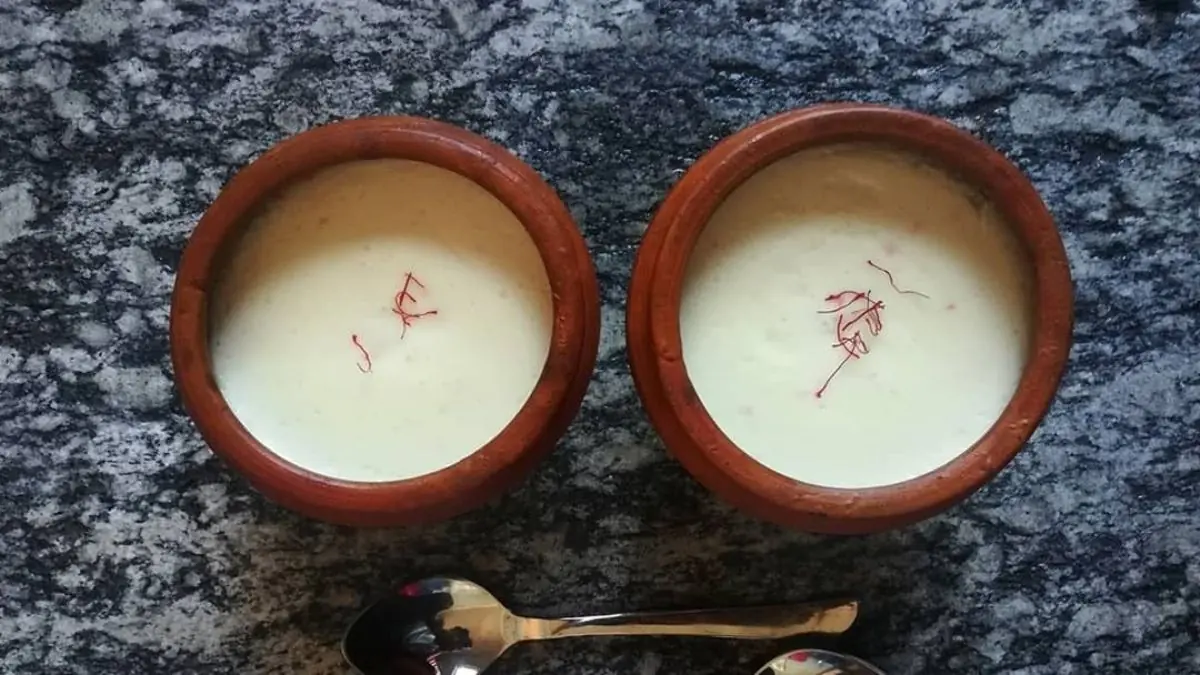
When you break the two words, you get ‘bhapa’, which means baked or steamed and ‘doi’, which means curd. Bhapa doi, a famous traditional Bengali sweet, is blended together with condensed milk, kesar milk and curd.
To bring out the richness in taste, it is flavoured with saffron, cardamom and a handful of rich, crunchy nuts. Bhapa doi is quite creamy and delicious, perfect for any occasion. It hardly takes over half an hour to prepare, and one can easily make it in a pressure cooker or a steamer.
After lunch or dinner, it’s the ideal dessert to satisfy a sweet tooth! Without sacrificing its essence, baked bhapa doi subtly elevates the traditional dish. Baking gives the dish a smoother, more custard-like texture because it distributes the heat more evenly than steaming. Each mouthful feels richer and more sophisticated since the top softly settles while the core remains creamy.
Particularly when prepared in larger quantities, bhapa doi is less prone to splitting or gett
When you break the two words, you get ‘bhapa’, which means baked or steamed and ‘doi’, which means curd. Bhapa doi, a famous traditional Bengali sweet, is blended together with condensed milk, kesar milk and curd.
To bring out the richness in taste, it is flavoured with saffron, cardamom and a handful of rich, crunchy nuts. Bhapa doi is quite creamy and delicious, perfect for any occasion. It hardly takes over half an hour to prepare, and one can easily make it in a pressure cooker or a steamer.
After lunch or dinner, it’s the ideal dessert to satisfy a sweet tooth! Without sacrificing its essence, baked bhapa doi subtly elevates the traditional dish. Baking gives the dish a smoother, more custard-like texture because it distributes the heat more evenly than steaming. Each mouthful feels richer and more sophisticated since the top softly settles while the core remains creamy.
Particularly when prepared in larger quantities, bhapa doi is less prone to splitting or getting gritty in the oven. The inherent tang and sweetness of the yoghurt and milk solids are enhanced rather than overpowered by the gradual, controlled baking.
Most importantly, baked bhapa doi feels more versatile and modern. It can be served as-is, topped with berries, caramel, or nuts, and even plated like a fine-dining dessert. It keeps longer, slices cleaner, and delivers consistent results—making it a great choice when you want tradition with a polished finish.