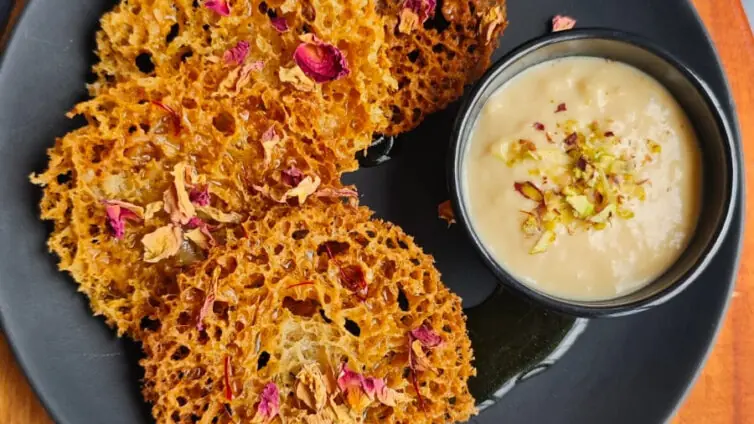
Step 1
Take ghee in a large bowl. Add ice cubes and whisk vigorously until the ghee becomes light and creamy.
Step 2
Gradually add maida and mix well to form a smooth mixture.
Step 3
Add chilled water little by little and whisk continuously. Keep adding water until you get a very thin, smooth and flowing batter. The consistency should be much thinner than dosa or pancake batter.
Step 4
Strain the batter once to make sure there are no lumps.
Step 5
Take a deep, wide and heavy-bottomed vessel. Add enough ghee/oil for deep frying and heat it properly.
Step 6
To check the temperature, drop a tiny amount of batter into the hot ghee/oil. It should immediately float and expand.
Step 7
Place a Ghevar mould/ring in the centre of the vessel, if using one.
Step 8
Take a ladleful of thin batter and pour it slowly from a height into the centre of the hot ghee/oil.
Step 9
Allow the batter to bubble and spread. Wait for a few seconds before pouring the next ladleful.
Step 10
Continue pouring the batter in small portions, preferably around the centre and over the existing layer, leaving the characteristic holes and pores.
Step 11
Use a skewer or the back of a spoon to gently make a hole in the centre if needed and continue adding batter.
Step 12
Keep frying until the Ghevar becomes golden, crisp and firm.
Step 13
Carefully remove the Ghevar from the hot ghee/oil and place it on a wire rack or plate to drain the excess fat.
Step 14
Repeat the process with the remaining batter.
Step 15
Add sugar and water to a saucepan and cook until the sugar dissolves and the syrup reaches a light one-string consistency.
Step 16
Add saffron and cardamom powder, if using. Mix and switch off the heat.
Step 17
Once the Ghevar has cooled slightly, drizzle or brush it with the prepared sugar syrup.
Step 18
Top generously with rabri, chopped almonds, pistachios and saffron.
Step 19
Garnish with rose petals or silver vark, if desired.
Step 20
Serve and enjoy this gorgeous traditional festive dessert!