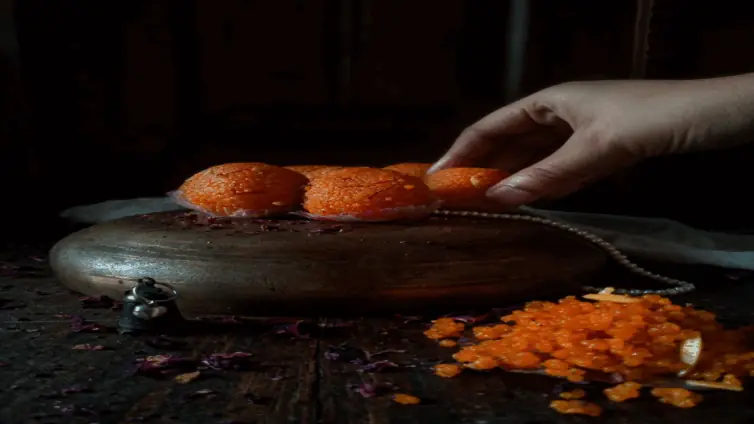
If you ask anyone which sweet is the trademark of every Indian celebration, motichur laddu will almost always come up. What sets motichur laddu apart from its cousin, the Boondi Laddu, is the size of its boondi. Instead of larger, coarser pearls, it is made with tiny, grain-sized droplets of fried gram flour batter, giving the sweet its irresistibly soft, velvety texture that melts away with every bite.
Initially, it might seem like a complicated sweet to prepare at home, but once you break down the recipe into manageable steps, it’s easier to get hold of it. The entire recipe hinges on three things: batter consistency, the frying method, and the syrup. The besan batter should be thin and smooth enough to pass through a perforated ladle in fine, even droplets. It should not be so thin that it spreads into a shapeless puddle in the hot ghee, and not so thick that it results in oversized and lumpy boondi. This step indeed requires practice, and the best method is to first test-fry
If you ask anyone which sweet is the trademark of every Indian celebration, motichur laddu will almost always come up. What sets motichur laddu apart from its cousin, the Boondi Laddu, is the size of its boondi. Instead of larger, coarser pearls, it is made with tiny, grain-sized droplets of fried gram flour batter, giving the sweet its irresistibly soft, velvety texture that melts away with every bite.
Initially, it might seem like a complicated sweet to prepare at home, but once you break down the recipe into manageable steps, it’s easier to get hold of it. The entire recipe hinges on three things: batter consistency, the frying method, and the syrup. The besan batter should be thin and smooth enough to pass through a perforated ladle in fine, even droplets. It should not be so thin that it spreads into a shapeless puddle in the hot ghee, and not so thick that it results in oversized and lumpy boondi. This step indeed requires practice, and the best method is to first test-fry a small batch instead of committing the whole batter to the pan.
The sugar syrup should reach a one-string consistency, as this will allow every droplet to absorb the sweetness while staying fluffy and moist. Once fried to a pale golden colour, dunk the boondi in a warm sugar syrup infused with cardamom and some strands of saffron. This is the make-or-break moment of your Motichur Laddu. Resting time matters here cause if you rush it, the laddus will crumble apart in your hands, and if you let it sit too long, the boondi turns overly soft and mushy. Then shaping is the final test of texture. Boondi should be gathered while still warm (not hot), and placing some ghee on your hand helps a lot.
Motichur laddus can’t be labelled as a quick weekday recipe, as it demands time in the kitchen and a bit of patience. But at the end of all this, the payoff is a batch of laddus that taste distinctly better than anything store-bought, with a texture no shortcut method quite replicates.