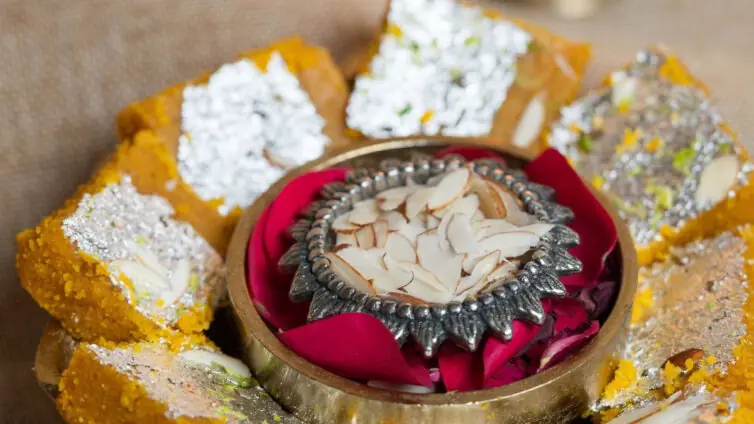
Mohanthal is a traditional Gujarati mithai made with roasted besan, ghee and sugar syrup, and finished with nuts and edible silver leaf. It remains a favourite on the mithai platter because of its welcoming fragrance and rich colour. Also, it has a distinct grainy texture and is different from the usual smoother barfis. This is because rubbing the besan with hot ghee and milk before roasting helps form small, soft granules instead of a smooth paste.
The beauty of Mohanthal lies in patience, but rushing the process by increasing the flame is one of the most common mistakes made by home cooks. This often results in an uneven colour or a raw, chalky aftertaste. The besan is slowly roasted on low heat until it turns golden and releases a toasty fragrance, signalling that it is ready. The roasted mixture is then mixed with a one-string sugar syrup, cardamom powder, and chopped nuts. After this, it is set in a tray, cooled, and cut into diamond-shaped pieces. Some households also add a tou
Mohanthal is a traditional Gujarati mithai made with roasted besan, ghee and sugar syrup, and finished with nuts and edible silver leaf. It remains a favourite on the mithai platter because of its welcoming fragrance and rich colour. Also, it has a distinct grainy texture and is different from the usual smoother barfis. This is because rubbing the besan with hot ghee and milk before roasting helps form small, soft granules instead of a smooth paste.
The beauty of Mohanthal lies in patience, but rushing the process by increasing the flame is one of the most common mistakes made by home cooks. This often results in an uneven colour or a raw, chalky aftertaste. The besan is slowly roasted on low heat until it turns golden and releases a toasty fragrance, signalling that it is ready. The roasted mixture is then mixed with a one-string sugar syrup, cardamom powder, and chopped nuts. After this, it is set in a tray, cooled, and cut into diamond-shaped pieces. Some households also add a touch of saffron-soaked milk at this stage for extra colour and fragrance.
Mohanthal is best enjoyed in small pieces, with its rich, fudgy and slightly grainy texture pairing well with tea or a festive mithai platter. It also stays fresh for over a week when stored properly, making it ideal for gifting, celebrations, or serving to unexpected guests during the festive season.