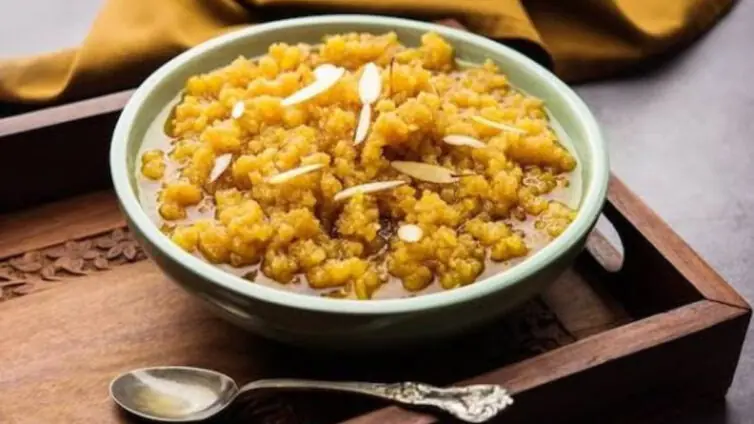
The arrival of the winter wedding season and festive celebrations across northern India instantly summons the rich aroma of moong dal halwa simmering gently in large brass cauldrons. Widely regarded as the ultimate test of patience, culinary skill, and dedication for home cooks, this iconic dessert is a true labour of love that rewards the chef with an unmatchable texture and depth of flavour. Historically prepared during grand weddings, Diwali festivities, and chilly winter evenings, this rich lentil pudding was originally designed to provide heavy nourishment and internal warmth, utilising generous quantities of pure ghee, wholesome dry fruits, and aromatic spices to combat the cold climate.
The preparation of authentic moong dal halwa is a masterclass in slow cooking and continuous stirring. Split yellow moong lentils are soaked for several hours, ground into a slightly coarse paste, and then patiently roasted in pure ghee over a low flame for nearly an hour. This continuous agitati
The arrival of the winter wedding season and festive celebrations across northern India instantly summons the rich aroma of moong dal halwa simmering gently in large brass cauldrons. Widely regarded as the ultimate test of patience, culinary skill, and dedication for home cooks, this iconic dessert is a true labour of love that rewards the chef with an unmatchable texture and depth of flavour. Historically prepared during grand weddings, Diwali festivities, and chilly winter evenings, this rich lentil pudding was originally designed to provide heavy nourishment and internal warmth, utilising generous quantities of pure ghee, wholesome dry fruits, and aromatic spices to combat the cold climate.
The preparation of authentic moong dal halwa is a masterclass in slow cooking and continuous stirring. Split yellow moong lentils are soaked for several hours, ground into a slightly coarse paste, and then patiently roasted in pure ghee over a low flame for nearly an hour. This continuous agitation and frying transforms the raw lentil paste into a golden, nutty crumb that hungrily absorbs warm milk, sugar syrup, and fragrant saffron. Garnished generously with slivered almonds and pistachios, every single spoonful offers a velvety, melting richness that has rightfully earned it the title of the undisputed king of winter celebration sweets.
Read More
Tips and Tricks
Soak your yellow moong dal evenly to a soft texture for seamless blending.
Grind your soaked lentils into a precise, coarse paste without adding water using the blending jar of a Mixer Grinder.
Roast your lentil paste slowly in ghee without burning or sticking by using a heavy-bottomed Hard Anodised Kadai.
Control the simmering temperature of your milk and sugar syrup precisely using an Induction Cooktop.
Slice your almonds and pistachios into fine, uniform slivers safely using a sharp Tru-Edge Kitchen Knife.