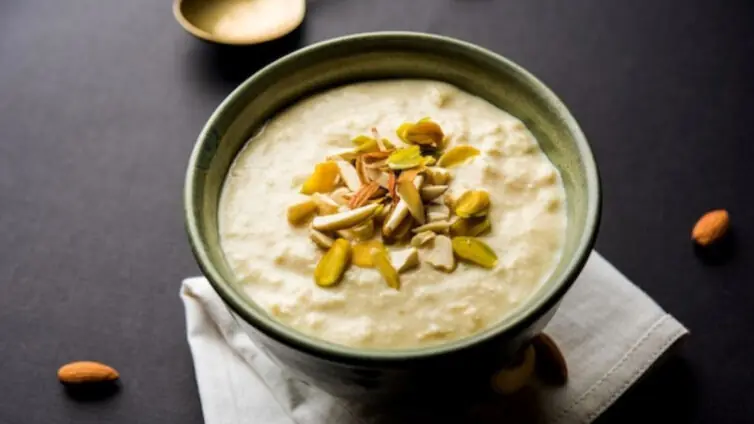
Basundi occupies a revered place in the festive culinary traditions of Western India, particularly across Gujarat and Maharashtra. Historically, milk-based sweets formed the backbone of celebratory feasts during major festivals like Diwali, Janmashtami, and Sharad Purnima. In agrarian communities, an abundance of fresh dairy was celebrated by simmering full-fat milk over slow fires for hours until it condensed into a rich, caramelised nectar. While similar to the North Indian rabri, basundi is distinct in its smooth, pourable texture, avoiding the thick, heavy layers of malai or cream that define rabri.
The beauty of a classic Gujarati recipe lies in its delicate balance of floral, warm spices and nutty textures. Whole milk is slowly simmered in a wide pan to encourage gentle evaporation. As the water content evaporates, the natural sugars in the milk concentrate and undergo mild caramelisation, giving the dessert its subtle golden tint and characteristic malty sweetness. Saffron threa
Basundi occupies a revered place in the festive culinary traditions of Western India, particularly across Gujarat and Maharashtra. Historically, milk-based sweets formed the backbone of celebratory feasts during major festivals like Diwali, Janmashtami, and Sharad Purnima. In agrarian communities, an abundance of fresh dairy was celebrated by simmering full-fat milk over slow fires for hours until it condensed into a rich, caramelised nectar. While similar to the North Indian rabri, basundi is distinct in its smooth, pourable texture, avoiding the thick, heavy layers of malai or cream that define rabri.
The beauty of a classic Gujarati recipe lies in its delicate balance of floral, warm spices and nutty textures. Whole milk is slowly simmered in a wide pan to encourage gentle evaporation. As the water content evaporates, the natural sugars in the milk concentrate and undergo mild caramelisation, giving the dessert its subtle golden tint and characteristic malty sweetness. Saffron threads, soaked in warm milk beforehand, bloom to release a brilliant yellow hue and a subtle earthy fragrance, while freshly crushed cardamom seeds add a sharp, aromatic lift that cuts through the creaminess.
For beginners, mastering basundi is an exercise in patience and attentiveness rather than complex technique. The key is maintaining a steady flame and stirring frequently to prevent the milk from scorching at the bottom of the pan. Blanched almonds, pistachios, and chironji seeds are folded in towards the end, providing a delightful crunch that contrasts with the silky liquid. Traditionally chilled before serving, basundi is frequently paired with piping hot, puffed puris during celebratory thalis, creating a classic contrast of hot and cold, savoury and sweet.