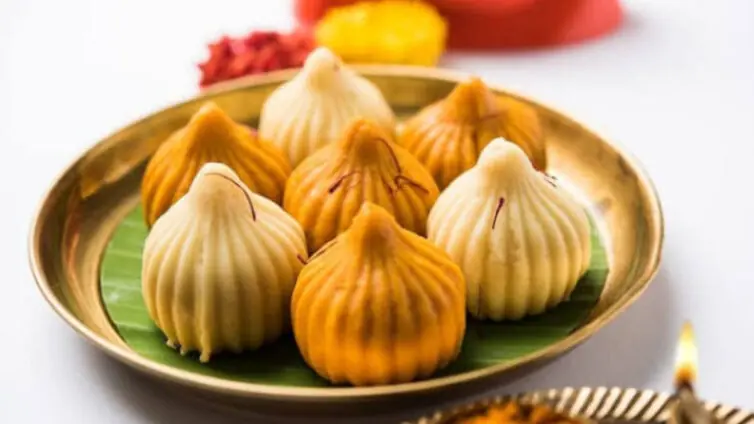
Modak holds a sacred place in Indian mythology and culinary history, renowned as the favourite sweet of Lord Ganesha, who is fondly addressed as Modakapriya. The term modak finds its roots in the ancient Sanskrit word moda, which translates to joy, delight, or happiness. References to this revered delicacy appear in classical texts including the Puranas, the Ramayana, and ancient Ayurvedic scriptures, highlighting its presence in ritualistic feasting for centuries. During the festival of Ganesh Chaturthi, offering a platter of twenty-one modaks as naivedya is considered the ultimate gesture of devotion, symbolising spiritual enlightenment and prosperity.
Beyond its religious symbolism, the modak is a celebration of seasonal, local ingredients. Traditionally prepared during the monsoon and early autumn, it reflects the bounty of fresh coconut harvests, newly processed jaggery, and fragrant rice varieties. The signature teardrop contour, resembling an unopened lotus bud or a bag of celes
Modak holds a sacred place in Indian mythology and culinary history, renowned as the favourite sweet of Lord Ganesha, who is fondly addressed as Modakapriya. The term modak finds its roots in the ancient Sanskrit word moda, which translates to joy, delight, or happiness. References to this revered delicacy appear in classical texts including the Puranas, the Ramayana, and ancient Ayurvedic scriptures, highlighting its presence in ritualistic feasting for centuries. During the festival of Ganesh Chaturthi, offering a platter of twenty-one modaks as naivedya is considered the ultimate gesture of devotion, symbolising spiritual enlightenment and prosperity.
Beyond its religious symbolism, the modak is a celebration of seasonal, local ingredients. Traditionally prepared during the monsoon and early autumn, it reflects the bounty of fresh coconut harvests, newly processed jaggery, and fragrant rice varieties. The signature teardrop contour, resembling an unopened lotus bud or a bag of celestial wealth, represents the containment of divine wisdom within a modest exterior. While the steamed ukadiche modak is deeply rooted in the cultural fabric of Maharashtra, regional variations flourish across the subcontinent, such as kozhukattai in Tamil Nadu and kozhukatta in Kerala. This enduring sweet bridges ancient spiritual folklore with living culinary heritage, preserving a tradition that brings families together across generations.
Read More
Tips and Tricks
Boil water rapidly for making the ukad dough by using an Electric Kettle.
Melt your jaggery and coconut filling smoothly with precise low temperature heat using an Induction Cooktop.
Steam your pleated modaks to a soft glossy finish without condensation dripping onto them by using a Steamer.
Grate fresh coconut into a fine and uniform texture effortlessly using the pulse function of a Mixer Grinder.
Ensure your rice flour dough cooks evenly without scorching along the base by using a heavy bottomed Kadai.